
Sisbén stratum: why this data doesn't exist and what they actually assign you
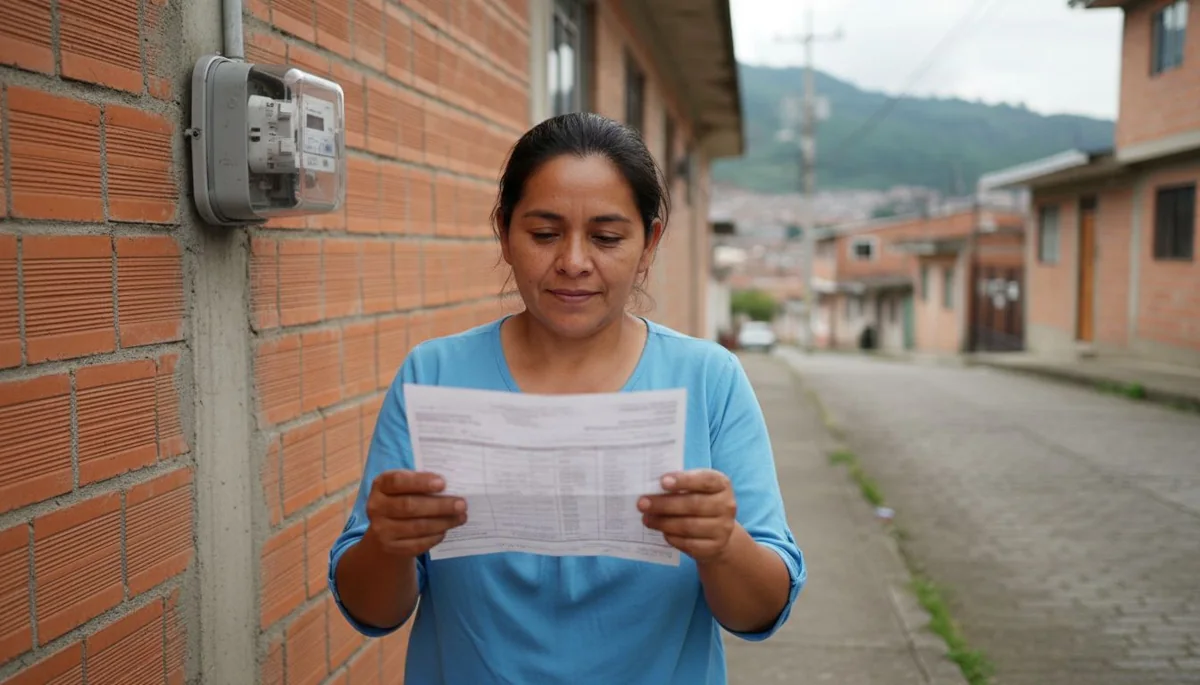
A woman from Itagüí wrote to us convinced that her Sisbén (social welfare system) status had been lowered because her electricity bill was still arriving as if she were in stratum 3. It hadn't been lowered at all. Sisbén stratum This information doesn't exist: the Sisbén system doesn't assign socioeconomic strata, and the mayor's office doesn't assign groups. They are two distinct classifications, created by different entities, about different things, and confusing them is the number one reason why a family believes they lost assistance that, in reality, never depended on that number.
Does the Sisbén stratum exist, or are they two different things?
They are two different things and neither comes from the other. The mayor assigns the socioeconomic stratum and classifies your home with a number from 1 to 6. The National Planning Department determines the Sisbén group and classifies your home with a letter: A, B, C, or D. You can live in a property in stratum 2 and be in group C, or vice versa, without any error.
The confusion has a concrete explanation, and it's the part that almost no one talks about. The Sisbén survey does ask about your house and your public services: that is, literally, the first of its five dimensions. Because the surveyor enters the home and notes the type of floor, the roof, and what services are available, the family gets the idea that this is how their socioeconomic stratum is determined. It isn't. That information is just one more piece of data used to estimate something completely different.
Who assigns the stratum and on what basis does it assign it?
The mayor assigns it, and it's not optional. Law 142 of 1994 states it explicitly: it is the mayor's "non-delegable duty to carry out the respective stratification." The mayor adopts the results by decree and notifies the Superintendency of Residential Public Services.
What's being classified isn't the family. DANE, the agency that designs and provides the methodologies to municipalities, defines it this way: stratification is "a classification into strata of residential properties that must receive public services," and the unit of stratification is "the residential property (house or apartment)." The neighborhood, the facade material, the sidewalk, the surroundings are all considered. The income of the person living inside is not taken into account.
That's why the socioeconomic stratum remains attached to the house when the family moves, and why two households with very different incomes can share the same number if they live in the same building. There are a maximum of six strata: 1 (low-low), 2 (low), 3 (lower-middle), 4 (middle), 5 (upper-middle), and 6 (high). There is also a ceiling that's important to know: no urban residential area that doesn't have at least two basic public services can be classified above stratum 4.
Who assigns the Sisbén group A, B, C or D?
The National Planning Department (DNP) determines your socioeconomic group using information from the survey conducted by your municipality. The DNP explains that the Sisbén system "classifies households and individuals into groups (A, B, C, and D) based on an estimated ability to generate income," according to their socioeconomic and demographic characteristics. The letter increases as the household's living conditions improve: A represents the greatest vulnerability, and D the least.
The survey covers five dimensions: housing and public services, health and fertility, education, occupation and income, and demographic background. Your home is one of these five, not the only one, and the result is not a socioeconomic stratum but an estimate of your household's income capacity. If you'd like a detailed explanation of what each letter means, we've broken it down in Sisbén score, and which group requests each program is in Sisbén groups for subsidies.
Why can your house be in stratum 2 and your home in group C?
Because they measure things that don't necessarily coincide. The socioeconomic stratum describes the physical environment of a property; the group describes people's economic capacity. A household with two adults in formal employment can rent a house in stratum 2 and still be classified in group C. A family without a stable income can inherit an apartment in stratum 4 and still be classified in group A.
Neither case is an inconsistency that needs fixing. It's the design working. The costly error occurs when someone tries to force the group by providing false data in the survey to make it fit the stratum, something we explain separately in How to move up a group in the Sisbén system.
What is the purpose of each person when you ask for help?
The socioeconomic stratum determines the cost of your utility bill. Subsidies on that bill go to strata 1, 2, and 3, while higher strata contribute a fee that, by law, cannot exceed 20% of the service cost. That's what you see reflected in... the public utility subsidy and in the gas subsidy.
The Sisbén group dictates the targeting of social programs: transfers, quotas, tuition. And here's a warning published by the DNP itself, which prevents many misguided complaints: having a Sisbén survey "does not, in itself, grant access to social programs." Being classified is the entry requirement, not the outcome. Each program defines its own selection criteria, and that's why we're writing. Why was my grant application rejected?.
How does each one correct itself if it went wrong?
They are two separate procedures, at two different windows, and sending them to the wrong place is what causes months to be lost.
If the problem lies with the assigned socioeconomic stratum, Law 142 allows "any person or group of persons" to request a review of their assigned stratum, and the first point of contact is the mayor's office. Each municipality also has a Permanent Stratification Committee, created by Law 732 of 2002, which oversees these claims. This is not a procedure to be carried out with the energy company or the National Administrative Department of Statistics (DANE).
If the group does not reflect your reality, you need to update the survey at the Sisbén office in your municipality, following the step-by-step instructions we provided in How to update the Sisbén survey. If you're not yet registered, start by How to register in Sisbén.
| What is being compared | Socioeconomic stratum | Sisbén group |
|---|---|---|
| What classifies | The residential property (house or apartment) | The home and the people who make it up |
| Who defines it | The mayor, using DANE methodology | The National Planning Department |
| How it is expressed | Numbers from 1 to 6 | Letters A, B, C and D |
| Where does the data come from? | Study of the environment and land base of the municipality | Household survey, with five dimensions |
| What is it used for? | Public utility subsidies and contributions | Targeting of social programs |
| Where to file a complaint | Mayor's office, review of the socioeconomic stratum | Sisbén office of the municipality |
Prepared by Hepacom using Law 142 of 1994 (articles 89, 101, 102 and 104), the DANE socioeconomic stratification form and the Sisbén page of the National Planning Department. Accessed on September 5, 2026.
Common mistakes that cost families money
- Claim the stratum at the service company. The company bills according to the decree issued by the mayor's office. Any requests for review are submitted to the mayor's office, and that's where the matter is resolved.
- Request an update of the Sisbén to lower the stratum. They are separate systems: changing the survey does not change the receipt number, but it can move the group in the opposite direction to what the family expected.
- Paying someone who promises to change either of them. Both procedures are free and are done directly with the entity. We compiled the options in subsidy scams.
Frequently asked questions about the Sisbén stratum
Does the Sisbén give me my socioeconomic stratum?
No. The Sisbén system assigns a socioeconomic group (A, B, C, or D) to your household. The property's socioeconomic stratum is assigned by the mayor and appears on your utility bill, not in your Sisbén inquiry.
If I move, does my socioeconomic status change?
Your socioeconomic stratum changes when you move to a new home, because the stratum is assigned to the property itself. Your Sisbén group doesn't change when you move; it changes when the household survey is updated.
Where can I find each one?
The socioeconomic stratum is shown on any utility bill for the residence. The group can be checked on the official Sisbén website using your ID, and the supporting documentation is explained in [link/section/etc.]. Sisbén certificate.
Does a low socioeconomic status guarantee me a Group A position?
No. They are independent measurements. There are households in stratum 1 classified as C, because the group estimates income-generating capacity and not the characteristics of the house.
Which one do they ask me for for the State programs?
Almost always the Sisbén group. The socioeconomic stratum appears as a requirement in housing programs and utility bill subsidies. The general list is in State aid and subsidies in Colombia.
How Hepacom accompanies you
At the Hechos Para la Comunidad Foundation, we work for the right to decent housing in Colombia, These two classifications determine very specific things for a family: how much their bill will be and which programs they can use. That's why we organize this information free of charge and in the language people ask about.
If you have any questions about your case, write to us at donaciones@hepacom.org or visit our website contact. Hepacom does not charge for registration nor does it manage payments for any State program.
You can verify all of the above in the source: the DANE socioeconomic stratification form, the DNP's Sisbén page and the text of the Law 142 of 1994 on Public Service.
Last updated: September 2026. Information guide. The process is handled by the official entity. Check the official channels of your mayor's office and the Sisbén system before filing any claim. Hepacom does not charge or process payments.
Keep reading — more about Sisbén, records and health
Difference between contributory and subsidized schemes: which one applies to you and what happens if you change jobs
Both systems offer the same benefits plan; what changes is who pays, what they charge for consultations, and whether they pay disability benefits.
Read more →Social Registry of Households: why your household is already included
There's no registration process: your home is already in. We explain which registries your information comes from, what you can do…
Read more →BDUA ADRES: What is the affiliate database and how to read it
At a health center, what your health card says isn't what matters: what matters is what's in the national membership database. We'll explain what that means…
Read more →EPS transfer: it takes 360 days, not a year, and the day you request it determines the month.
It's not twelve months: it's 360 days, and they are added together even if they weren't consecutive. Today we reviewed Decree 780 of 2016 and the official portal…
Read more →Your donation builds the next home
If this story touched you, turn it into a roof for a Colombian family.
Donate now ♥