
Difference between contributory and subsidized schemes: which one applies to you and what happens if you change jobs
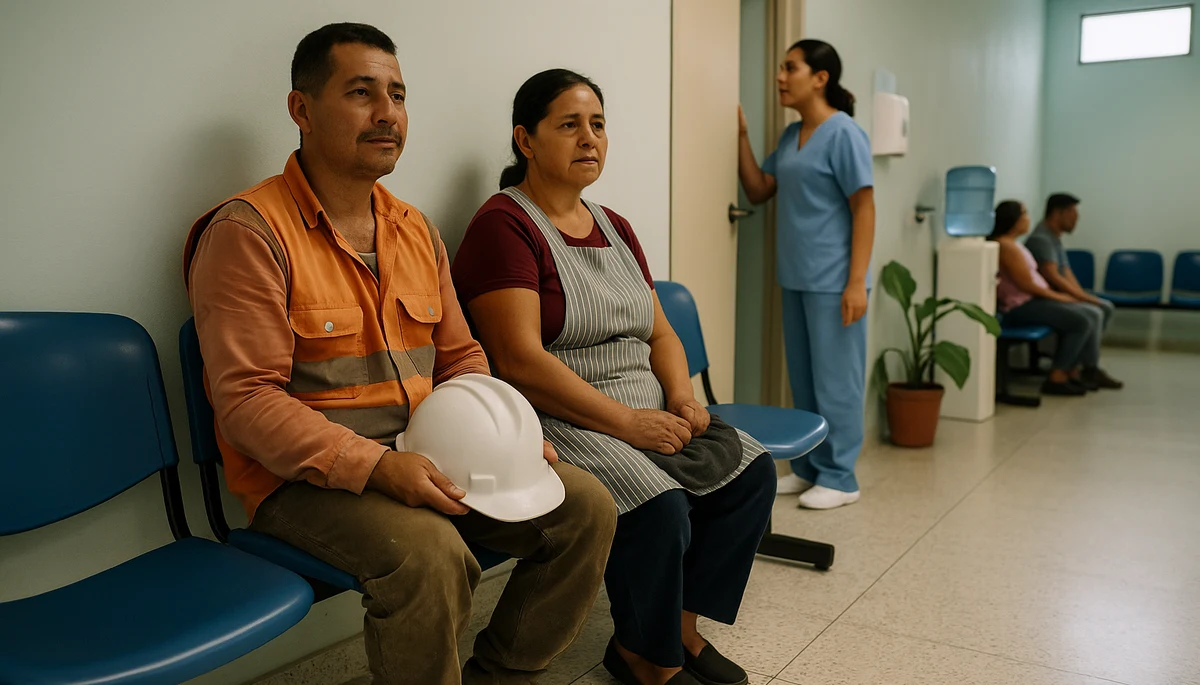
A construction worker and an arepa vendor can sit in the same waiting room, see the same doctor, and leave with the same prescription. What separates them isn't visible in the doctor's office: he has 41% of his salary deducted for health insurance every month, while she pays nothing because the state covers her affiliation. That, in a nutshell, is the difference between contributory and subsidized schemesIt's not the service that changes, but who pays. Here's what you need to know about each one, what they charge, and what to do when you change jobs.
What is the difference between a contributory and a subsidized healthcare system?
The contributory system is for those who have the means to contribute: employees with contracts, public servants, pensioners, and self-employed individuals with the ability to pay. The subsidized system is for people without the ability to pay and is financed by the State. This is established by Article 157 of Law 100 of 1993.
What many families don't know is that the benefits plan has been the same in both systems since July 1, 2012, when the old POS (mandatory health plan) was fully unified: the same consultations, tests, surgeries, and medications are included. The real differences lie in who pays the money, what is charged for consultations, whether disability benefits are paid, and how you switch from one system to the other.
If you don't know which one you're on, check it for free at the EPS consultation at ADRESShow your EPS and your regime.
Which health plan is right for you based on your situation?
It's not a matter of personal preference. It depends on your job and your Sisbén classification.
- Employment contract or public office: contributory. The contribution is 12.5% of the salary: 4% comes from your salary and 8.5% is paid by the employer.
- Independent with ability to pay: contributory. You pay the full contribution, on a basis never less than one minimum wage.
- Pensioner: contributory, with the contribution deducted from the monthly payment.
- Without income to contribute to social security and with Sisbén in groups A, B or C: Subsidized, without paying for membership. The same applies to special populations listed in the census, such as indigenous communities.
- Sisbén in group D and without a way to contribute: subsidized by solidarity contribution, a partial rate set by the Ministry of Health and collected by ADRES.
Resolution 1870 of 2021 establishes the Sisbén IV income brackets: level 1 ranges from A1 to B7 and level 2 from C1 to C18. This level determines whether you pay co-payments. If you don't know your group, start with the Sisbén score, And if you get the subsidized one, the steps are in the guide. subsidized health insurance system.
What changes between the two regimes, point by point?
This is the difference between the contributory and subsidized healthcare systems in nine points. We compiled it by cross-referencing Law 100 with its decrees, because no official source provides the complete information.
| Spot | Contributory system | Subsidized regime |
|---|---|---|
| Who enters | Employees, public servants, pensioners and self-employed individuals with the ability to pay | People without the ability to pay: Sisbén A, B and C, special populations and group D through solidarity contribution |
| Who pays | 12.5% of the salary: 4% the worker and 8.5% the employer; the self-employed person pays everything | The State, in solidarity contribution, a partial fee for each adult in the household |
| Benefits plan | The same since July 2012 | The same since July 2012 |
| Co-payment | Yes, it depends on your base contribution income. | No, not in any service (except for solidarity contributions) |
| Co-payment | Only the beneficiaries, according to the contributor's income | Level 1 (A1 to B7) exempt; level 2 (C1 to C18) pay |
| Disability and maternity leave | Yes, for those who pay into the system. | There is no cash payment |
| Family | Your core group is included as a beneficiary | Your immediate family comes with you. |
| Attention in another municipality | Portability | Portability |
| If your situation changes | Mobility to the subsidized plan within the same EPS (Health Promoting Entity) | Mobility to the contributory scheme within the same EPS |
Difference between contributory and subsidized health insurance plans. Prepared by Hepacom using Articles 157, 204, 206, and 207 of Law 100 of 1993, Decree 780 of 2016, Decree 1652 of 2022, and Resolution 1870 of 2021 of the Ministry of Health. Accessed September 13, 2026. Contribution and co-payment amounts change annually: confirm them with your EPS (Health Promoting Entity).
Common mistakes when comparing the two systems
- Believing that you get fewer services in the subsidized system. The plan is the same. If they deny you something included, the problem lies with the EPS (health insurance provider), not your health insurance plan.
- Requesting a transfer of EPS (Health Promoting Entity) when what changed was your job. That is mobility, a different procedure that takes priority over relocation.
- Assuming that losing your job means losing your health that same day. There is a period of job protection and then several exit options depending on your Sisbén.
How much do they charge for the consultation under each plan?
These are two separate charges. co-payment Payment is made when using outpatient consultations, therapies, or prescription medications. co-payment It is part of the value of a service, such as a procedure or hospitalization.
In the contributory scheme, the co-payment is paid by the contributor and their dependents, while the co-insurance is paid only by the dependents, both based on the contribution base income. Those undergoing regular treatment for diabetes, hypertension, rare diseases, or mental disorders, among other diagnoses, do not pay a co-payment.
In the subsidized healthcare system, there are no co-payments: Decree 1652 of 2022 exempts "those enrolled in the Subsidized Regime, for all services they require." Co-payments are not made by children in their first year of life, for childbirth complications, by those in Sisbén Level 1, or by several populations listed in the census. Level 2 does pay co-payments, and the solidarity contribution covers co-payments, co-payments, and deductibles.
In both systems, high-cost events such as transplants or kidney failure do not require a copayment. The amounts are set periodically by the Ministry: ask your EPS (Health Promoting Entity) for the current table. And in the emergency room, they cannot demand the co-payment upfront for treatment.
What happens to your health if you get a job or lose your job?
This is where most families get tangled up. The key rule is mobility: Article 2.1.7.7 of Decree 780 of 2016 defines it as changing your health insurance plan within the same EPS (Health Promoting Entity), if it operates in both, with your family unit and without interrupting care.
If you were on unemployment benefits and you get a job: The change is registered on the same day you start working, along with your employer, and you switch to the contributory system without changing your EPS (Health Promoting Entity). It's not a transfer, which has its own rules for remaining in the system (we explain them in...). EPS transfer).
If you were on the contributory scheme and you lose your job: Article 2.1.8.1 grants you an additional month of job protection if you have been with the same EPS (Health Promoting Entity) for at least twelve months, and three months if you have been with them continuously for five years or more. If during that time your claim is approved... Unemployment Protection Mechanism, The compensation fund continues to cover your health.
When those protections run out, there are three paths: with Sisbén A, B or C, you request mobility to the subsidized one in the same EPS; if the Sisbén is not enough for you, you enter as a beneficiary of a family member who contributes; and with group D without income, the mobility is through a solidarity contribution, and the EPS has to inform you beforehand of the rate for each member of the household.
The transition to the subsidized plan is registered from the day after the contract ends, and at the latest by the last day of that month, or upon the expiration of your job protection if you had it. If you don't do this, the EPS (Health Promoting Entity) must report it and notify you, but it's advisable to do it yourself and then check your status. BDUA of the ADRES.
What about disability benefits and maternity leave?
Here's the difference between the contributory and subsidized healthcare systems that's most noticeable at home. Articles 206 and 207 of Law 100 assign the contributory system the payment of disability benefits for general illness and maternity leave to those who contribute. Under the subsidized system, you receive care for illness and childbirth, but no one compensates you financially for the days you were unable to work.
The exception: female heads of household affiliated through the solidarity contribution system can receive maternity compensation proportional to their contribution, according to Article 5 of Law 2114 of 2021. Therefore, if you are self-employed and have the means to contribute, the contributory system covers the days when illness prevents you from working and the rent bill continues to arrive.
Frequently asked questions about the difference between contributory and subsidized healthcare systems
Can I be on both systems at the same time?
No. Each person appears under only one system, and if the system detects multiple affiliations, it verifies them and cancels the extra ones.
Do I have to change my EPS (health insurance provider) to switch to the contributory system?
No, if your EPS (health insurance provider) operates under both systems. If it only operates under one, ask them how your affiliation will be affected before starting work.
Will I receive care at the subsidized clinic if I move to another city?
Yes. Portability covers all members, regardless of their health plan, when they leave their municipality occasionally, temporarily, or permanently. Notify your EPS (Health Promoting Entity).
How Hepacom accompanies you
At the Hechos Para la Comunidad Foundation, we work for the right to decent housing in Colombia, And health is closer to that issue than it seems: an unpaid disability or a lost affiliation directly impacts what a family can pay in rent.
If you have any questions about the difference between the contributory and subsidized pension schemes in your case, write to us at donaciones@hepacom.org or visit our website contact. You can also see the map of State aid and subsidies in Colombia. Hepacom does not affiliate with any EPS (Health Promoting Entity), does not charge for guidance, and does not manage payments for any State program.
Check it at the source: the Law 100 of 1993, articles 204 to 207, he Decree 780 of 2016 on Public Service, he Decree 1652 of 2022, the Resolution 1870 of 2021 and the solidarity contribution to ADRES.
Last updated: September 2026. Information guide. The procedure is handled by the official entity. Verify through the official channel before taking any action. Hepacom does not collect or process payments.
Keep reading — more about Sisbén, records and health
Sisbén stratum: why this data doesn't exist and what they actually assign you
The Sisbén system doesn't assign socioeconomic strata, and the mayor's office doesn't assign groups. Who assigns each group, what does it assign it to, why might your house be included...
Read more →Social Registry of Households: why your household is already included
There's no registration process: your home is already in. We explain which registries your information comes from, what you can do…
Read more →BDUA ADRES: What is the affiliate database and how to read it
At a health center, what your health card says isn't what matters: what matters is what's in the national membership database. We'll explain what that means…
Read more →EPS transfer: it takes 360 days, not a year, and the day you request it determines the month.
It's not twelve months: it's 360 days, and they are added together even if they weren't consecutive. Today we reviewed Decree 780 of 2016 and the official portal…
Read more →Your donation builds the next home
If this story touched you, turn it into a roof for a Colombian family.
Donate now ♥