
Community kitchens: who can eat and how to find one nearby
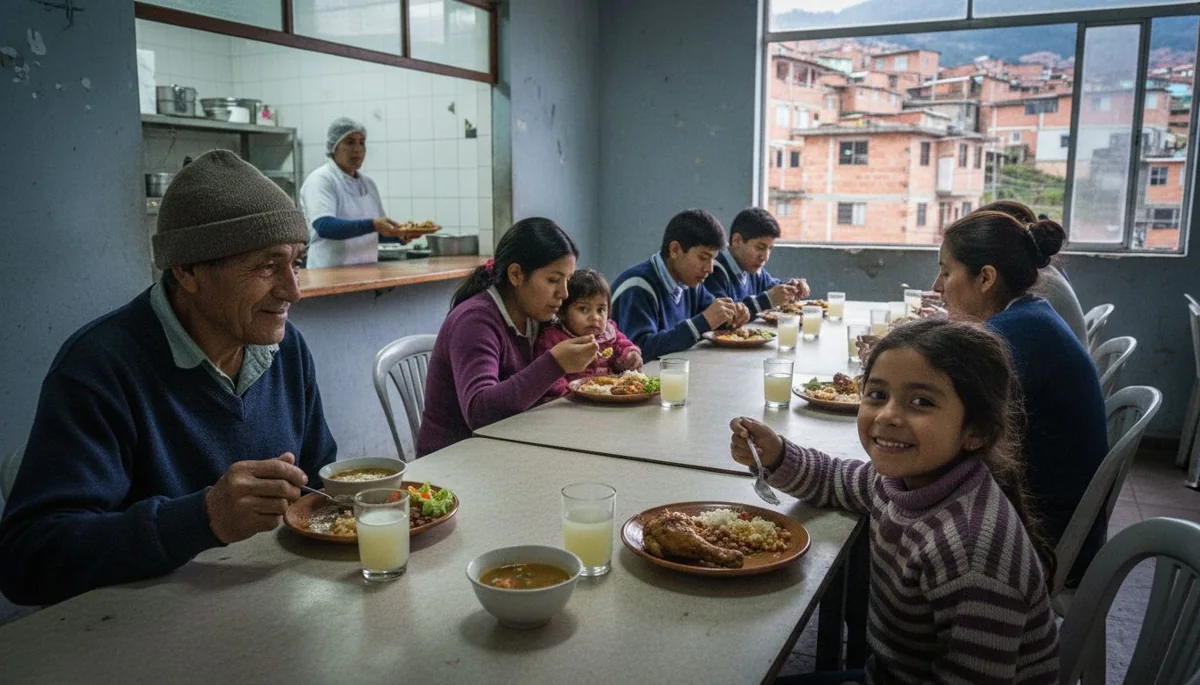
When money doesn't stretch far enough each month, the first thing to be cut in a house isn't the rent, because the rent doesn't wait. Food is cut. community dining halls They exist to fill that gap: a hot meal at lunchtime, Monday through Saturday, so that a child or a grandparent doesn't have to go hungry to pay for the cost of keeping a roof over their head. Here's what they are, who can eat there, how to get in, and how to find the one closest to you, along with the rules published by the organization that runs them.
What are community kitchens and who runs them?
These are physical spaces within the neighborhood where a hot meal is served to people living in poverty or at risk of hunger. In Bogotá, they are managed by the District Secretariat of Social Integration, and its official service portfolio (version 25, April 2026) defines them as a physical, social, and community space to guarantee access to food.
This dish is no ordinary meal. According to the document, the serving provides the equivalent of 40% of the daily recommended intake of energy and nutrients, calculated by age group using Resolution 3803 of 2016 from the Ministry of Health. Simply put: it's a complete lunch, designed by nutritionists, not a snack.
Something almost no one knows: the soup kitchen also takes weight and height measurements to detect malnutrition early, and they guide families on other district services. It's often the gateway to other forms of assistance.
Who can eat in a community kitchen?
The general rule is simple: people over one year old who live in Bogotá and are in extreme poverty, moderate poverty, or vulnerable due to food insecurity. This is measured using Bogotá's Sisbén IV system.
According to the Secretariat's portfolio, those with classifications A1 to A5, B1 to B7, or C1 to C9 are eligible. Group D is excluded. If you're still unsure which group you belong to, we'll explain it in [link/section/etc.]. Sisbén groups for subsidies and in Sisbén score.
There are also routes for those whom the Sisbén system doesn't cover:
- Children and adolescents aged 1 to 17 years who do not have their own classification, but whose home is in groups A, B or C, verified with the Sisbén or with the Social Registry of Households.
- Homeless people who are on the official census.
- People who live in daily pay residences.
- Indigenous or Romani people registered in the official lists of their communities.
Meeting the condition does not automatically grant you a spot. There is one more step, which we explain below.
Who gets priority if there isn't enough room for everyone?
When there are not enough slots, service is not provided on a first-come, first-served basis: the portfolio establishes prioritization criteria.
In addition to the Sisbén groups, the following are also considered: children and adolescents, people over 60, pregnant women, people with disabilities, victims included in the Single Registry of Victims, homeless people, and registered ethnic communities.
If someone in your household belongs to one of those groups and the registry doesn't show them, fix that first. A disability that isn't listed in the Sisbén system, or a victim who never filed a report, is a priority that the system can't see.
How does a family register at community kitchens?
The local service team handles the application process, specifically the local Social Integration sub-directorate for your area. The program outlines two access methods: by request, when the individual applies, and through other means, when the Secretariat cross-references the databases of the Sisbén and the Social Registry of Households.
The practical order is as follows:
- Confirm your Sisbén IV group and that your record is valid and your name is in Bogotá.
- Find the dining room closest to your home on the official map (we explain how in the next section).
- Go to the local Social Integration sub-directorate in your town (they can guide you at the dining hall) and bring your identity document and that of those who will be eating.
- The local team will conduct an on-site verification of your conditions.
- If you are approved, you sign a co-responsibility agreement.
That agreement is what's most often misunderstood. It's not a contract with fine print: it's a set of commitments regarding attendance and cohabitation. But failing to comply, after due process, is grounds for dismissal. Read it before signing and ask about anything that's unclear.
How can I find community kitchens near my location?
Using the official map of Bogotá, not lists circulating on social media. The Secretariat publishes a layer called "Community Dining Hall" in its geoviewer, and this same layer can be accessed from the District's open data portal and from Bogotá Maps. Each location is displayed there with its address, phone number, neighborhood, and hours of operation.
When we consulted it, on September 24, 2026, it had 142 dining halls. Almost all of them had the same schedule: Monday to Friday from 10:30 a.m. to 3:00 p.m., and Saturdays from 10:30 a.m. to 2:00 p.m., excluding holidays and Easter Saturday.
This is how they are distributed by location, which is what people ask about most:
| Locality | Dining areas on the official map |
|---|---|
| Bolivar City | 23 |
| Usme | 16 |
| Bosa | 16 |
| Saint Christopher | 13 |
| Kennedy | 13 |
| Rafael Uribe Uribe | 13 |
| Suba | 9 |
| Santa Fe | 7 |
| Tunjuelito | 5 |
| Fontibón | 5 |
| Engativá | 5 |
| Usaquén | 4 |
| Aranda Bridge | 4 |
| Chapinero | 3 |
| The Martyrs | 2 |
| Candlemas | 2 |
| Antonio Nariño | 1 |
| United Neighborhoods | 1 |
| Total | 142 |
Map created by Hepacom using the "Community Dining Hall" layer from the geoviewer of the District Secretariat of Social Integration, published on the Bogotá open data portal and consulted on September 24, 2026. The map may not reflect recent openings or closures: confirm with the local sub-directorate before visiting.
Two quick observations. The south concentrates the offerings: Ciudad Bolívar, Usme, Bosa, San Cristóbal, Kennedy, and Rafael Uribe Uribe account for 94 of the 142. And there are two districts with no points on the map, Teusaquillo and Sumapaz. For Sumapaz and for ethnic households, the Secretariat has another service, "Commitment to Inclusive Food," which delivers monthly food baskets or vouchers to households in ethnic communities and rural areas.
Common mistakes that leave a family without their meal
- Moving to a different town without notifying us. If the move prevents you from getting to your soup kitchen, that's grounds for dismissal. Before moving, ask at the local sub-office about a soup kitchen near your new address.
- Allowing the Sisbén record to remain in a status other than valid, after a year of service, will also remove the person from the program.
- Believing you can be everywhere at once. The portfolio lists other District services, such as the Crecer Centers or the Amar Centers, which cannot be combined with the dining hall.
What happens if I don't live in Bogotá or there are no available spots?
The rules described above apply to Bogotá. In the rest of the country, soup kitchens and community kitchens are run by each municipality or regional government, or by parishes and social organizations, and each sets its own conditions. Check with the social development or social inclusion department of your municipality, and be wary of any "registration" via WhatsApp that asks for your personal information or money.
If there's no room, there are more doors. food banks They work with organizations that distribute markets, and the ICBF community homes They provide food and care to young children. To see the full map of support services, check our guide. State aid and subsidies in Colombia.
Frequently asked questions about community kitchens
Do community kitchens charge?
No. It's a social service provided by the District. If someone asks you for money for a spot, don't pay and report it to the Social Integration Secretariat.
Can I go out to eat one day without being a member?
The service operates with registered beneficiaries and a signed agreement. Ask at the soup kitchen or the local sub-office how to begin the enrollment process.
What happens if my Sisbén moves up to group D?
According to the portfolio, exceeding the C9 level after one year of support is grounds for dismissal. The change isn't immediate, but it does happen.
Can babies eat in the dining room?
The service is for people over one year old. For younger children, check the early childhood programs offered by the ICBF and the District.
How does Hepacom support you?
At the Hechos Para la Comunidad Foundation we work for the decent housing in Colombia, And we know that food and shelter come from the same pocket. Every lunch a family doesn't have to buy is money that can go toward rent, repairs, or saving for a home of their own. If your family is looking for ways to access a housing subsidy, start with our guide to housing subsidies in Colombia.
If you have any questions, write to us at donaciones@hepacom.org or visit our website contact. Hepacom does not register anyone in the dining halls, does not charge for guidance, and does not manage payments for any program.
Check it at the source: the portfolio of services of the District Secretariat of Social Integration, from where the requirements, priorities, and exit causes come, and the layer of Community dining halls in open data from Bogotá, with the location of each one. For direct assistance, use the Social Integration support channels.
Last updated: September 2026. Information guide. The procedure is handled by the official entity. Verify through the official channel before taking any action. Hepacom does not collect or process payments.
Keep reading — more about State subsidies and aid
Ayudas y subsidios del Estado en Colombia: la guía para tu familia
Mapa claro de las ayudas y subsidios del Estado en Colombia: Sisbén, Renta Ciudadana, IVA, Colombia Mayor, vivienda y cómo evit…
Read more →BEPS de Colpensiones: qué es, quién puede ahorrar y cómo se vuelve un ingreso para la vejez
Guía de BEPS de Colpensiones: qué es, quién puede ahorrar, cómo vincularse, el incentivo del Estado y la diferencia con la pens…
Read more →Jóvenes en Acción ahora es Renta Joven: requisitos 2026
Jóvenes en Acción Renta Joven: requisitos verificados, cómo postularse y por qué hoy no hay inscripciones. Cuidate de los sitio…
Read more →Subsidio del adulto mayor: qué programas hay, cómo consultar y cuándo pagan
Guía del subsidio del adulto mayor en Colombia: qué programas existen (Colombia Mayor, alcaldías, Centros Vida, BEPS), cómo con…
Read more →Your donation builds the next home
If this story touched you, turn it into a roof for a Colombian family.
Donate now ♥