
Sisbén family group: who is on your record and how to change it
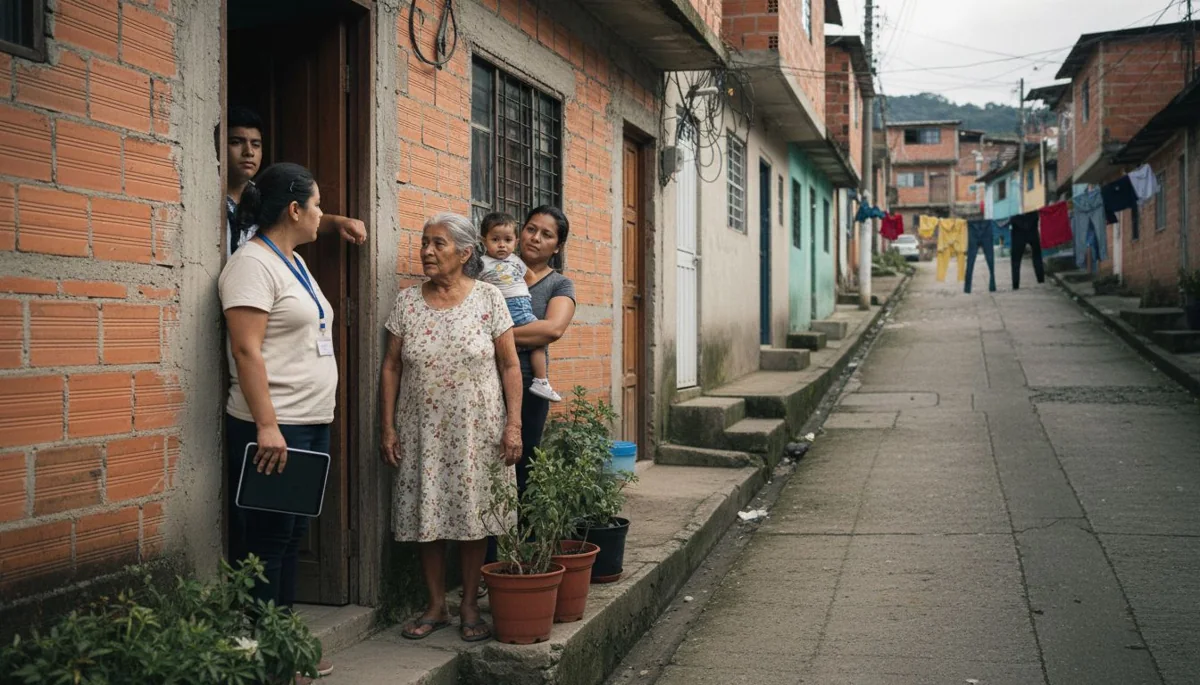
Most people discover who's on their file the day they're denied something. A mother applies for benefits and is told that a brother who left four years ago has reappeared at her home, with a salary she never saw. Sisbén family group It's not a list of your relatives: it's a list of those the State believes live and eat with you, and from there comes the A, B, C, or D group that opens or closes doors. Here we explain who really counts, what that list looks like, and what procedure is needed for each change.
What is the Sisbén family group and who is included?
It's the household registered in your file, and kinship isn't the determining factor. The Sisbén IV operating manual from the National Planning Department defines a household as a person or group of people, related or not, who occupy all or part of a dwelling, meet basic needs using a common budget, and generally share meals.
Read those last two conditions carefully, because they're the deciding factors. The shared budget and the family's food supply matter more than your last name. Your cousin who sleeps in the back room and contributes to the grocery shopping is part of the family. Your married daughter who lives two blocks away isn't.
This is where the most costly misunderstanding in the system arises. The classification doesn't measure what you earn; it measures the income-generating capacity of the entire household. One extra person who no longer lives there affects the whole group. We explain how this translates into the letter you see when you check your status in the [section/section/etc.]. Sisbén groups for subsidies and in Sisbén score.
Who counts as a household member and who doesn't?
The rule is called habitual residence, and the DNP manual defines it by name. A habitual resident is someone who lives permanently or most of the time in the dwelling, even if they are absent on the day of the survey. Also counted as habitual residents are those who are absent for less than six months for special reasons, such as a short training course, displaced persons regardless of how long they will stay, and those performing military service but sleeping at home.
On the other side is the list that almost no one knows about. Those who study or work elsewhere and return on weekends or holidays, those who live in boarding schools, people incarcerated in prisons, and those performing military service who do not sleep at home are not considered permanent residents.
That detail matters. The son who went to study in Medellín and returns every two weeks isn't a permanent resident, even if his clothes are still in the closet. If he's still on the register, he's inflating the income of a household where he no longer eats.
And the head of household is not appointed by an official: he is identified by the members themselves for economic, age or authority reasons, and the minimum age to be one is fourteen years old.
How can you see who appears on your profile?
To be honest: the quick ID-based search is designed to show your classification, not the complete household composition. If you need a list of household members, there are two methods that will provide it in writing.
The first is the Sisbén Citizen Portal. According to the DNP manual, anyone who wants to consult their information and carry out update or modification procedures must register there, and the system assigns them a username and password. The second is hardly ever used: every time you make a request at the municipal office, they have to give you a copy, and that copy lists both the person who requested the procedure and the members of their household.
Keep that copy: it's the only document that tells you, in black and white, who the government has living in your house. And be careful with the domain name, because that's where scams happen: the official one is sisben.gov.co. Websites with a hyphen in the name, like sisben-gov.co, are not government sites, and you shouldn't give them your ID number.
How to include someone in the Sisbén family group?
The process is done in person at the Sisbén municipal office in your borough, and there's a limit that almost no one knows about. It's requested as a modification of personal data, requiring the presentation of identification documents. The DNP manual is explicit: a maximum of two people can be added. When three or more are added, the process is no longer an addition but a new survey to validate the changes these new members bring to the household.
And don't try to add them two at a time. The manual calls that verification for recurring inclusions: a household that requests another inclusion shortly after having done so is flagged. It's not a fine, but it slows down your registration just when you need it most.
Your municipality, not the DNP, is responsible for processing your applications. The municipalities receive the applications and then report any changes to the DNP for validation.
How to remove someone from the household in the Sisbén system?
It's also an in-person process, and it comes with a safeguard that you should understand before going. The request to remove an individual, the entire household, or the file must be submitted by a qualified informant who is a regular resident, along with their identification. A qualified informant is someone who lives there, knows the dwelling and the family relationships, and is of legal age.
Now for the surprising part. To remove a person over 18 from the program, the manual requires that they do so in person at the Sisbén office. If they cannot go, they must send a signed authorization from a household member over 18. The DNP explains the purpose of this requirement: to prevent unwanted removals from households.
It sounds awkward when the exit was a fight. But it's the same rule that prevents someone from kicking you out without you knowing.
What procedure applies to each situation in the house?
The third column is the most important, because almost all mistakes stem from going to the wrong place:
| What happened at the house | What procedure is it | Where is it done? | The overlooked detail |
|---|---|---|---|
| A child was born or a relative (one or two people) came to live with us | Inclusion of people, such as modification of people's data | Municipal Sisbén office, in person, with identification documents | The limit is two people per application |
| Three or more people came to live in the home | New survey, no inclusion | It is requested at the municipal office and the survey is applied in the home. | The entire household is being characterized again, not just those who arrived. |
| Someone left the house or passed away | Withdrawal of person from the record | Sisbén municipal office, with the qualified informant's document | If the person is over 18, they must go in person or send a signed authorization. |
| The household moved from one house, neighborhood, or municipality to another. | New survey | Sisbén office in the territory where they now live | This is mandated by article 2.2.8.3.2 of Decree 441 of 2017 |
| Did someone's ID card, name, job, or education level change? | Updating people's data | Sisbén municipal office, with the document and a copy | The change must be demonstrable. |
Prepared by Hepacom using the Sisbén IV operating manual from the National Planning Department, consulted on September 20, 2026. Each mayor's office defines its service points and hours: confirm them with your municipality before going.
Common mistakes that cost a family their subsidy
- Do not assume that the ID-based search shows the entire household. Show your classification. To see the list of household members, you must access the Citizen Portal or request a copy of the application at the office.
- Adding people two at a time to avoid the new survey. The system flags recurring entries and the registration remains under review.
- Moving without notifying the authorities. A change of address is not a minor update: it requires a new survey in the territory where the household now lives.
Frequently asked questions about the Sisbén family group
Can I include my newborn child?
Yes, it's for registering individuals at the municipal Sisbén office by presenting identification documents. It falls within the limit of two people per application.
Should my child who studies in another city remain on my record?
According to the DNP manual, someone who studies or works elsewhere and only returns on weekends or holidays is not considered a regular resident of the household. That is the criterion the agency applies.
Can I remove someone without them knowing?
No. If the person is over 18, they must go to the Sisbén office in person or send a signed authorization. This rule exists precisely to prevent unauthorized withdrawals.
Can the process be done online?
The Citizen Portal is online, but enrollment and removal are handled at the Sisbén municipal office in your borough. Check with your borough to see how it's working.
If I correct my file, will I receive the subsidy?
Not automatically. The DNP clarifies that being a beneficiary of a social program does not depend on the local Sisbén offices or the DNP, but on the entity that defines the rules of each program.
How does Hepacom support you?
At the Hechos Para la Comunidad Foundation, we work for the right to decent housing in Colombia, And the Sisbén record is the gateway to almost everything that helps a family own their own home. A record with people who no longer live there isn't an administrative error: it's a housing subsidy that's not being delivered, and a Citizen's Income that falls apart. The Sisbén family group is reviewed before it is needed, not after.
If you don't know where to start, write to us at donaciones@hepacom.org or visit our website contact. Our guides will also be helpful. How to update the Sisbén survey and from social register of households. Hepacom does not register anyone in Sisbén, does not charge for guidance, and does not manage payments for any program.
Check it at the source: the official website of Sisbén at the National Planning Department and the Sisbén IV operating manual, from which the definitions and procedures cited in this guide come.
Last updated: September 2026. Information guide. The procedure is handled by the official entity. Verify through the official channel before taking any action. Hepacom does not collect or process payments.
Keep reading — more about Sisbén, records and health
Cómo actualizar la encuesta del Sisbén paso a paso
Aprendé a actualizar la encuesta del Sisbén paso a paso: cuándo hacerlo, qué documentos llevar y por qué el trámite es gratis y…
Read more →Certificado de discapacidad: cómo sacarlo paso a paso, cuánto cuesta y para qué sirve
Guía del certificado de discapacidad: quién lo expide, paso a paso para pedir la orden y la valoración, plazos, costo, para qué…
Read more →RUI inquiry: how to do it with your ID card and what happens to your subsidies
The Universal Income Registry (RUI) has been in effect since August 1, 2026. How to check your status using your ID card at the service window…
Read more →Difference between contributory and subsidized schemes: which one applies to you and what happens if you change jobs
Both systems offer the same benefits plan; what changes is who pays, what they charge for consultations, and whether they pay disability benefits.
Read more →Your donation builds the next home
If this story touched you, turn it into a roof for a Colombian family.
Donate now ♥